Custom Data Wizard - Quick Start Guide
Retrieve any external data you can imagine, in any of 17 languages, using AI
Welcome! This guide walks you through Interzoid's Custom Data Wizard from your first lookup to your first API call. The wizard lets you describe what data you want, in your own words, and get back structured results in seconds. No SQL, no schemas, no scraping. Just describe the data and it's retrieved.
One Data Definition. Three Ways to Use It. The same definition you build in this wizard can be used three different ways:
Interactive
Run one-off lookups directly in the wizard for research, validation, or quick decisions.
Batch
Save the definition, then enrich entire CSV or TSV files with our batch enrichment tools.
Live API
Your definition auto-deploys as a REST endpoint, immediately callable from your apps.
What you'll learn:
- How to access and navigate the Custom Data Wizard
- How to start from a sample template or build your own from scratch
- How to define a topic and output fields
- How to enter a lookup value and retrieve results
- How to save your configuration, copy your results, and reuse the auto-generated API URL
- How to switch the entire interface between 17 languages
Looking for the product page first? Click here.
1Open the Custom Data Wizard
Navigate to the wizard in your browser:
URL: https://custom-data-wizard.interzoid.com
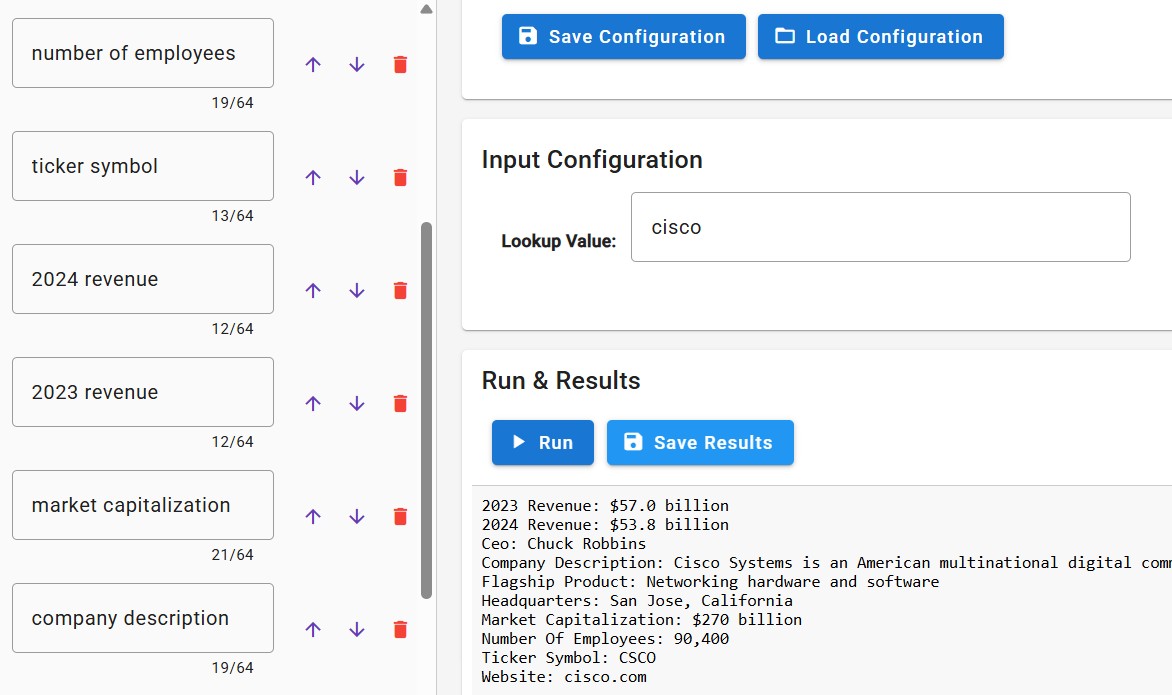
The wizard is a guided five-step flow. The header at the top shows your progress through the steps, and you can move forward or back at any time. Across the top of every step you'll also find:
- Your API key field (paste it once and the wizard remembers it for you)
- A Check Credits button to confirm your remaining usage
- A globe icon for switching the interface between 17 languages
Don't have an API key yet? Register for free trial credits at interzoid.com. Once you're logged in you can retrieve your key from your account page.
2Choose a Starting Point
On the second step the wizard asks how you want to begin. You have two choices:
- Start From a Sample. Pick one of 40+ ready-made templates covering business and finance, corporate intelligence, global registries, real estate, sales, security, sports, news, and more. Samples are organized into expandable categories. Selecting one fills in the topic, output fields, and a representative lookup value, all of which you can then edit.
- Start From Scratch. Build your own data definition from a blank canvas. Full control, no presets.
Already built a configuration in a previous session? On the welcome screen you'll see a "Have a saved configuration? Load it here to skip ahead" link. Click it, pick your saved .izparams.json file, and the wizard jumps straight to step 3 with your topic and fields already populated.
3Define Your Output Fields
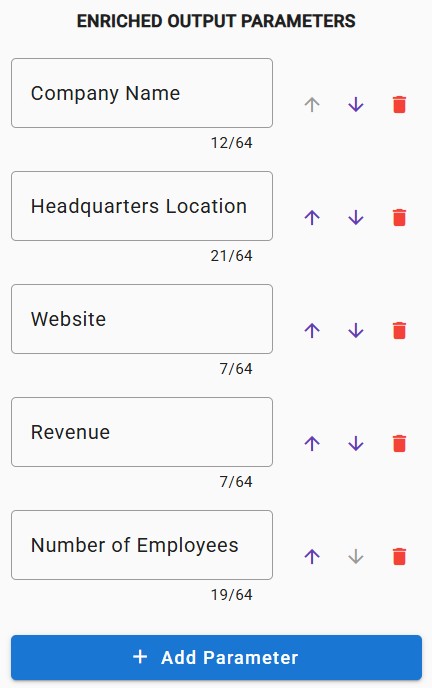
This is where you describe what data you want to retrieve. The step has two parts.
Topic. A short paragraph (up to 512 characters) describing the kind of data the AI should return. The topic gives the AI essential context and dramatically affects the quality of your results.
- "Comprehensive information about world countries including demographics and economics"
- "Professional sports team statistics and performance data"
- "Company financial metrics and business information"
- "Medical conditions, symptoms, and treatment options"
Output Data Fields. Below the topic, list the columns you want returned. Each field has a name you choose. Up to 10 fields per request.
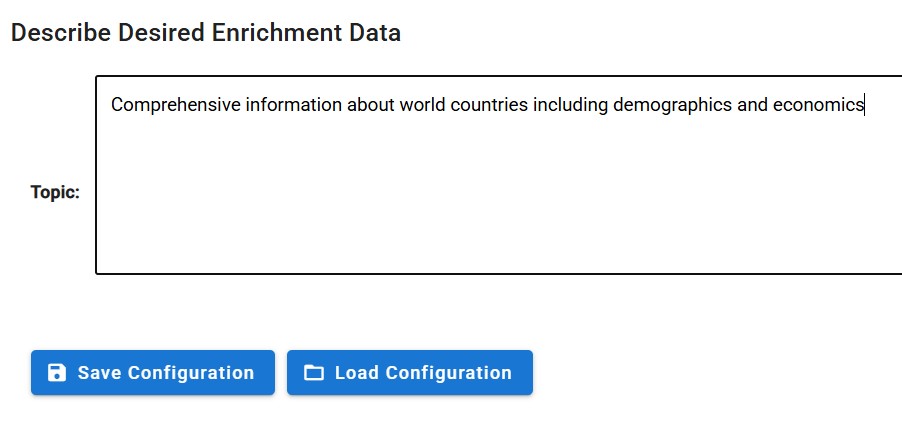
How to manage your fields:
- Click + Add Data Field to add a new row (up to 10)
- Type the field name directly. Field names guide the AI, so descriptive names yield better results.
- Use the up and down arrows to reorder fields
- Use the ✕ button to remove an unwanted field
- Population
- Capital City
- Official Language
- Currency
- GDP
At the bottom of this step you'll find Save Configuration and Load Configuration buttons. Save your topic and fields to a small .izparams.json file at any time. You can reload it later in the wizard, or feed it into our batch enrichment tools to apply the same definition across an entire dataset.
4Enter Your Lookup Value
The lookup value is the specific subject the AI will research. Your topic and fields tell the AI what kind of information to return; the lookup value tells it about which entity.
Examples of lookup values:
- "France" or "Japan"
- "Apple Inc." or "Tesla"
- "Los Angeles Lakers" or "Manchester United"
- "Diabetes" or "Hypertension"
- Any subject you want data about
Tips for better results:
- Be specific. "Cisco Systems" usually beats just "Cisco".
- For people, include the company or context, like "Satya Nadella Microsoft".
- For addresses, the more complete the address the better, like "1600 Pennsylvania Ave Washington DC".
- For ambiguous names, add a qualifier. "Apple Inc" not just "Apple".
5Run and View Your Results
The final step shows a summary of your configuration. Review it, then click to retrieve your data.
Results appear in the panel below within seconds, formatted as field-name and value pairs. Above the results you'll find:
- Save Results to download the output as a text file
- Pretty View to open a formatted modal that highlights the lookup value and lays out each field cleanly. Useful for screenshots and quick visual review.
- Copy Results to copy the full output to your clipboard. The button shows a checkmark for two seconds to confirm.
- Enter New Lookup Value to jump back one step and run the same definition against a different subject without rebuilding it.
- Start Over to clear everything and return to the welcome screen.
Below the results, a panel titled "Want to integrate this as an API?" displays the auto-generated API call URL. This URL is the exact live REST endpoint for the configuration you just built. Copy it (the copy button also shows a checkmark when successful), paste it into your apps, ETL pipelines, or Web forms, and it works immediately. No additional setup, no deployment step.
Quick Tips for Success
- Start simple. Begin with 3 or 4 fields and expand as needed.
- Be specific. Detailed topic descriptions produce much better results than vague ones.
- Use field names that guide the AI. "Headquarters City" is clearer than "Location".
- Save promising configurations. A good definition is reusable across thousands of lookup values.
- Try a sample first. The 40+ templates show what works well, then customize from there.
Common Use Cases to Try
A few popular examples to get you started:
- Business Research: company revenues, employee counts, headquarters, industries
- Geographic Data: country populations, capitals, languages, currencies
- Sports Analytics: team statistics, championships, player counts, stadiums
- Academic Research: university rankings, enrollment, tuition, notable alumni
- Product Information: specifications, prices, features, manufacturers
6Switch the Interface Language
The wizard's interface is available in 17 languages: English, French, German, Italian, Spanish, Japanese, Portuguese, Chinese, Arabic, Dutch, Greek, Turkish, Korean, Swedish, Vietnamese, Thai, and Indonesian.
Click the globe icon (🌐) in the top navigation bar at any time to open the language menu. Your selection is remembered between sessions. You can also pass ?lang=fr (or any supported code) in the URL to set the language directly when linking from documentation or sharing the tool.
Important. The interface language is independent of the language of your data. You can ask for results in any language by writing your topic, fields, and lookup value in that language. For example, with the interface set to English you can still ask for "Información sobre empresas españolas" with fields like "ingresos" and "empleados" and get Spanish-language results back.
7Beyond Interactive Use
Once you're comfortable with the wizard, the same data definitions unlock two additional ways to use them:
- Batch Enrichment. Save your configuration with the Save Configuration button, then upload the resulting
.izparams.jsonfile along with a CSV or TSV of lookup values to enrich.interzoid.com. You'll get back a fully enriched file with your custom fields appended as new columns, processed in parallel for speed. - Live REST API. Every configuration auto-deploys to the Interzoid platform as a callable API. Use the URL shown on the Run and Results step in your applications, websites, ETL/ELT pipelines, internal tools, or anywhere else you need real-time external data.
For batch processing details, see the batch processing guide. For full API documentation, see the AI Data Enrichment API reference.
You will need an API key. Get it by logging into your account. If you don't have an Interzoid account yet, register for free trial credits at www.interzoid.com.
Ready to Get Started?
Open the Custom Data Wizard and retrieve your first dataset right now.
Need help? Contact support@interzoid.com for assistance.
You are now ready to use the Custom Data Wizard to retrieve any external data you can imagine. Whether you run it once for a quick lookup, save it as a data definition for batch enrichment, or deploy it as a live API, the same data definition supports all three.